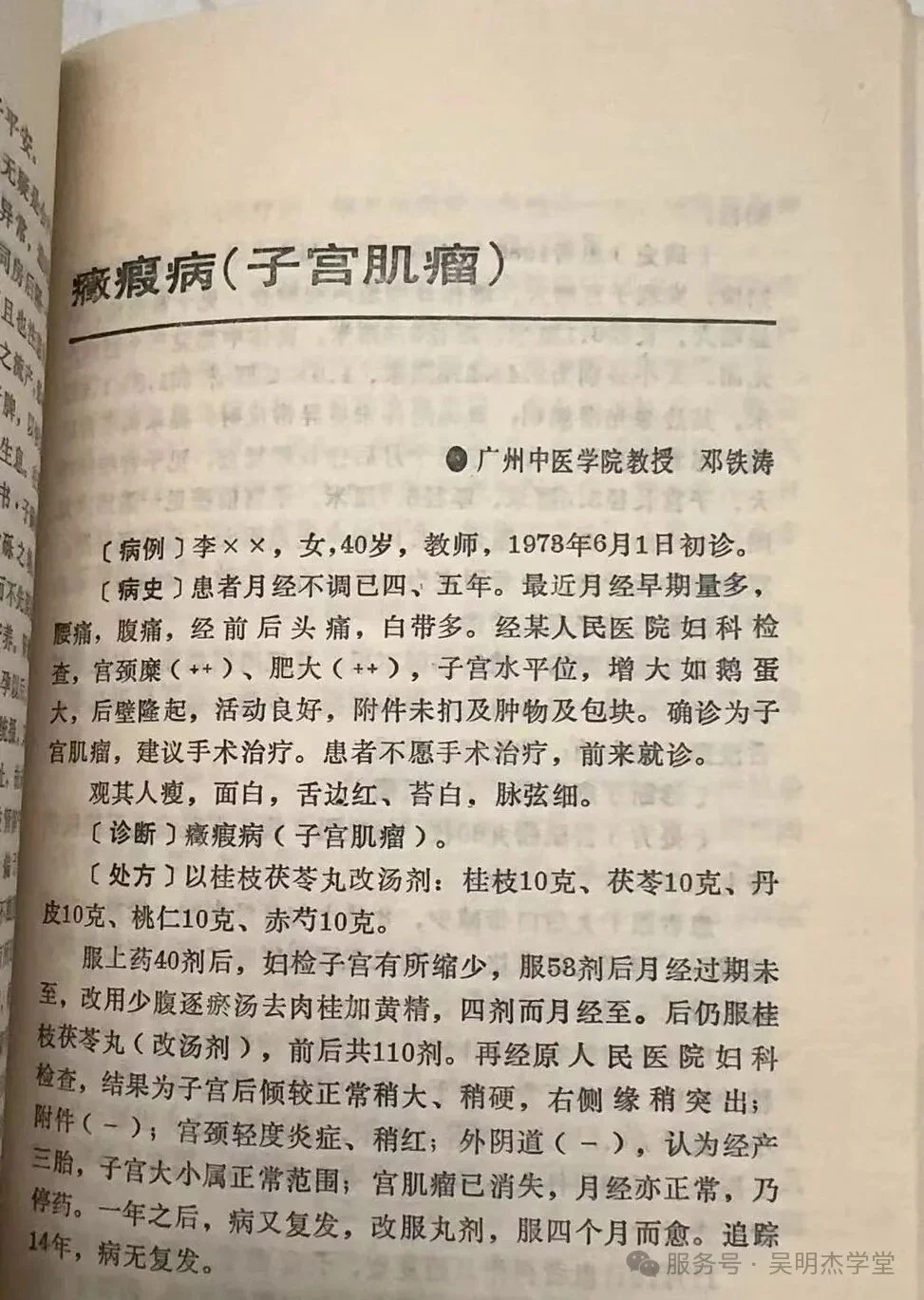
Zhengjia Disease (Uterine Fibroids) — Professor Deng Tietao, Guangzhou College of Traditional Chinese Medicine
Case 1
Li ××, female, 40 years old, teacher. First consultation: June 1, 1973.
Medical History
The patient had suffered from irregular menstruation for four to five years. Recently, her menstrual periods came early with heavy bleeding, accompanied by lower back pain, abdominal pain, headaches before and after menstruation, and excessive vaginal discharge.
A gynecological examination at a local People’s Hospital revealed:
* Cervical erosion (++),
* Cervical hypertrophy (++),
* The uterus in a horizontal position,
* Enlarged to the size of a goose egg,
* Posterior uterine wall protrusion,
* Good mobility,
* No palpable masses in the adnexal region.
She was diagnosed with uterine fibroids, and surgery was recommended. However, the patient refused surgical treatment and sought Traditional Chinese Medicine therapy instead.
On examination, she appeared thin and pale; the sides of the tongue were red with a white coating, and the pulse was wiry and thready.

Diagnosis
Zhengjia disease (uterine fibroids).
Prescription
Modified decoction of Gui Zhi Fu Ling Wan:
* Cinnamon Twig (Gui Zhi) — 10 g
* Poria (Fu Ling) — 10 g
* Moutan Bark (Dan Pi) — 10 g
* Peach Kernel (Tao Ren) — 10 g
* Red Peony Root (Chi Shao) — 10 g

After taking 40 doses, gynecological examination showed that the uterus had reduced in size. After 53 doses, menstruation was delayed and did not arrive, so the prescription was changed to Shao Fu Zhu Yu Tang, removing Rou Gui and adding Huang Jing. After four doses, menstruation resumed.
She then continued taking the modified Gui Zhi Fu Ling Wan decoction, totaling 110 doses.
A follow-up examination at the original hospital showed:
* The retroverted uterus was only slightly enlarged and slightly firm,
* The right border protruded slightly,
* Adnexa negative,
* Mild cervical inflammation with slight redness,
* External genital tract normal.
The physicians concluded that, after bearing three children, the uterine size was within the normal range; the fibroid had disappeared, and menstruation had returned to normal, so medication was discontinued.
One year later, the condition recurred. She then switched to pill form therapy and recovered after four months. Follow-up over 14 years showed no recurrence.